Showing posts with label National Nutrition Month. Show all posts

Tuesday, March 27, 2018

National Nutrition Month Roundup


We're nearing the end of March and National Nutrition Month (NNM). Here's my NNM Round-up in cased you missed anything this month.


The theme of National Nutrition Month this year was Go Further with Food.


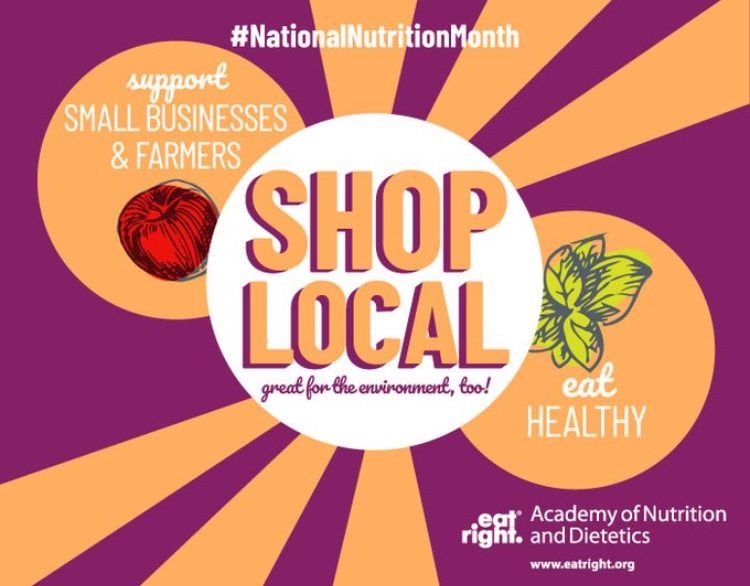
Eating and shopping locally is a huge movement. I would encourage you to go to your local farmer's market to see what's growing in your area. I've also done a few posts about what's in season year round and what's in season in autumn. 


I have a lot of clients that want a quick fix for being healthy or to be on a diet that gets them to the goal weight tomorrow. A "diet" is how you eat, your meal pattern, your food preferences. It is a lifelong thing. I'm a supporter of small, doable changes that are sustainable over a lifetime. So, here's my recipe for health


One of the most common barriers to healthy eating is cost. Many people believe that healthy eating is expensive. It doesn't have to be! Here are my 6 tips for meal planning on a budget


Healthy eating is important to prevent disease and promote health. I love starting my day off with breakfast. Breakfast provides you with fuel for the day. If you find it difficult to eat breakfast, here are a couple tips to jump start your morning and fuel your day with breakfast


Stay tuned to the blog, FacebookPinterestInstagram, and Twitter for recipes and more.


Are there any topics you want me to cover? Or, any recipes you would like to see on the blog. I'm always open to suggestions. If you have an idea, topic, or question, feel free to comment below.  


If you enjoyed this post, you may enjoy:


Monday, March 19, 2018

6 Tips to Meal Plan on a Budget

Budgets – everyone has them. Unless you’re lucky enough to have a money tree in your backyard or become rich and famous, budgeting is a reality.


Healthy eating has so many benefits. It helps children grow and develop to their full potential. It helps prevent diseases and nourishes your body.

Many of my clients state that their budget is the biggest barrier to eating healthy. I don’t think this has to be true. With a little planning, you can eat healthy and stay within your budget.

Eating healthy can be done on a budget.

Here are a few of my tips to meal plan, eat healthy, and stay on budget.

1) Make a meal plan.
- Start with a meal plan. Plan out the meals, sides, and snacks you and your family will eat for the week. Take into account any nights you may eat out.
- A meal plan helps you build a grocery list, which can help you stay on budget.

2) Make a grocery list.
- Make your grocery list at home, and stick to it at the store.
- If you’re under budget and something you regularly use is on sale, I make an exception to the grocery list “rule.”

3) Look for coupons and store discounts.
- When I meal plan, I look at my grocery store’s weekly ads and coupons on their app. If I plan meals around what’s on sale, I can easily stay on budget.


4) Eat in season.
- Produce grows at different times of the year. When produce is in season, it’s cheaper. You can find out what’s in season by checking online at More Matters or at your local farmer’s market. One of the reasons that in-season foods are cheaper is that they are grown locally and don’t have to be shipped as far. This reduces costs for the grocery store and you. 

5) Try canned or frozen produce.
- Canned or frozen fruits and vegetables can be cheaper. These foods are picked in season and preserved by canning or freezing. This is cost effective for the farmers and saves you money.
- I like to have a mix of fresh, canned, and frozen fruits and vegetables available.  I try to use my fresh produce at the beginning of the week. Then, I use the canned and frozen foods toward the end of the week.  These leads to less food waste and saves money!

6) Make things at home instead of eating out.
- The cost of a meal at a restaurant is so much higher than cooking a home. Try to cook at home more often than eating out. We try to limit eating out to 1-2 times per week. See what works for your family.
- Here’s a challenge.  Try making your favorite restaurant meal at home. Compare the prices. Also, compare the time. Does it take less time to cook the meal or drive and order the meal? I would love to hear your findings.

What are your thoughts?
Do you have any tips for healthy eating on a budget?

What's your favorite meal to make at home?

What's your favorite app for coupons or budget shopping?

For more tips and recipes for a healthy lifestyle, you can follow me on FacebookPinterestInstagram, and Twitter

If you enjoyed this post, you may enjoy:


SaveSaveSaveSave
SaveSave

Monday, March 12, 2018

Recipe for Health

What’s the recipe for being healthy?

I would say it’s fueling your body with healthy foods + mental health + emotional health + adequate rest + activity. Today, we are focusing on one piece of the health recipe, physical activity. Activity is any form of movement that you enjoy.


I feel like the term "exercise" gets a bad rap. For most of my clients, exercise is kind of a dirty word. It tends to be associated with a “should do” or “have to” mentality. What I mean by that is, most people say a “should exercise” or I “have to” exercise.

Physical activity or movement is something that is important to your health. We know physical activity increases in strength, cardiovascular endurance, flexibility, and so much more.


How do you change a “should” into a “want to”?

I think we can enjoy exercise. Find something you love to do that gets you moving. I love dancing, so I tried several types of dance and barre classes. I also LOVE the water, so water sports are one of my favorite ways to be physically active, when the weather is cooperative. 


What are examples of physical activity?

Physical activity can be done anywhere – inside your home, at a park, at the gym. It doesn’t have to be expensive. You don’t have to join a gym. You can walk around your neighborhood or dance to music in the comfort and privacy of your own home. You can join a recreational sports league. There are so many different types of physical activity: sports, walking, swimming, exercise classes, strength-training, cycling, dance, yoga, Pilates, rock climbing, step class, kayaking, etc. I challenge you to try something new.

My challenge to you is to try something new.


What are your thoughts?

What type of physical activity do you enjoy?

What keeps you motivated to be physically active?

Have you tried any new types of physical activity?

I would love to hear your thoughts. Comment below or on Instagram, and Twitter.

If you enjoyed this post, you may enjoy:


5 Tips to Eat More Fruits & Vegetables 

For more tips, encouragement, and recipes for a healthy lifestyle, you can follow me on FacebookPinterestInstagram, and Twitter

Monday, March 5, 2018

Fuel Your Day with Breakfast

What’s the most important meal of the day? Did you say breakfast?


I would content that all meals are important. Much research has been conducted around breakfast. We know breakfast is an important meal.
  • Breakfast helps jumpstart our metabolism after fasting all night.
  • Kids that eat breakfast do better in school (1).
  • Eating meals and snacks throughout the day helps reduce hanger (you know – hunger-induced anger). This is both funny and true. Low-blood sugar, which can result from skipping meals, increases irritability. So friends, hanger is real.
I’ve been a registered dietitian (RD) for almost 10 years.  Many of my clients have several common barriers to eating breakfast. The most common barriers are time and lack of appetite. 


If you are rushed in the morning, consider these time savers:

1) Make breakfast the night before.
- You can have breakfast for dinner and reheat leftovers in the morning.  Try my frittata recipe. It’s great for breakfast, brunch, or breakfast for dinner.


2) Prep for a quick breakfast.
- Make a smoothie pack in the freezer. In the morning, you can blend the smoothie
- Try overnight oats or museli. These breakfast cereals can be mixed with milk, yogurt, or a dairy alternative and can sit in the fridge overnight.  Try adding fruits or nuts to have a balanced breakfast with a variety of foods.

3) Build a balanced meal.
To build a healthy meal, incorporate at least 3 different food groups. Try to include 1 or 2 servings of fruits or vegetables at every meal.


4) Try drinking your breakfast.
If you don’t have a big appetite in the morning and you're pushed for time, try having a small breakfast or drinking your breakfast. Try a smoothie or fruit and yogurt. These are small, quick and easy breakfasts.


What are your thoughts?
What is your favorite thing to eat for breakfast?
Do you find it easy or difficult to eat breakfast?
I would love to hear your thoughts. Feel free to comment below or comment on Instagram or Twitter.

If you enjoyed this post, you may enjoy:


References:

1) Faught et Al. Healthy lifestyle behaviors are positively and independently associated with acadmic achievement: An analysis of self-reported data from a nationally representative sample of Canadian early adolescents. PLoS One: 2017; 12 (7). Available at: https://www.ncbi.nlm.nih.gov/pmc/articles/PMC5533436/.
SaveSaveSaveSaveSaveSave

Thursday, March 1, 2018

National Nutrition Month 2018

National Nutrition Month is a celebration held every March since 1980. It was created by the Academy of Nutrition and Dietetics (AND). Every year there is a different theme to promote nutrition education. The theme for 2018 is Go Further with Food. This year’s theme emphasizes the importance of fueling your body with healthy foods and physical activity. This month we will cover the following topics: breakfast, nutrition and physical activity, and healthy eating on a budget.

National Nutrition Month 2018

As a registered dietitian (RD), my goal is to provide helpful nutrition information that is supported by science. I want you to be an informed consumer. To be an informed consumer, look at the author’s credentials to determine their depth of knowledge and qualifications to cover a subject. If you want to know more about my qualifications or how to become a RD, check out the following posts.


I hope you have a fantastic March. Let me know if you have any nutrition-related questions in the comments.

If you enjoyed this post, you may enjoy:


Tuesday, March 28, 2017

National Nutrition Month Roundup

March is National Nutrition month. The theme for 2017 is Put Your Best Fork Forward. This month, I shared nutrition tips and recipes to help you eat seasonally, meal plan, and cook healthy meals for you and your family.


I love educating children and their families about healthy eating. Healthy eating starts with making smart choices at the grocery store, preparing foods in a healthy way, and choosing healthy meals and snacks. Healthy eating is a lifestyle. If we make healthy choices today, these choices add up to a healthy tomorrow.
If you missed anything this month, here are the nutrition tips and recipes:


Thank you for celebrating National Nutrition Month with me. My hope is that you developed healthy eating habits this month that you will continue. Let’s keep putting our best fork forward.
Remember every time you eat, you can make healthy choices. What healthy choices did you make this month? What healthy choices do you plan to continue or try in the future?
Please comment below. I would love to hear your healthy choices. Feel free to tag me, @RDtipoftheday, with your healthy choices. Also, use the hashtag #healthyRD for the chance to be featured. Remember your health is a journey. Choose the healthy road.
For more tips, encouragement, and recipes for a healthy lifestyle, you can follow me on FacebookPinterestInstagram, and Twitter

If you liked this post, you might enjoy:

Tuesday, March 21, 2017

7 Tips for Healthy Eating on a Budget

Happy National Nutrition Month! This month I'm focusing on the 2017 theme - Put Your Best Fork Forward. So far, we covered why eating breakfast is important and 7 breakfast ideas to start every day healthfully. I hope those topics have been helpful.

One of the most common barriers to healthy eating is the idea that healthy eating is more expensive. I think this is a common misconception. Making healthy meals at home is cheaper and more economical than eating out. Today, I'm going to share my tips for healthy eating on a budget.

Set a budget.
Making healthy choices within in your budget is important for everyone. Start with setting a reasonable food budget. Healthy boundaries, like a budget, are important parameters to set before shopping.

While I'm shopping, I like to keep a running total of the things I'm buying. As I put groceries in my cart, I keep a rough estimate of the total cost of my grocery haul.


Make a list.
Include items for breakfast, lunch, dinner, and snacks.
Include foods from all food groups: grains, fruits, vegetables, meat or protein, and dairy or dairy alternatives.
If you make a list, you are less likely to make a spontaneous or impulse purchase, which adds to your grocery expenses.


Use coupons.
I like to look at coupons I get in the mail or specials on the grocery store's website as I make my grocery list. My grocery store also sends specific coupons to me based on things I usually purchase. I love it! Most stores also have apps where you can download electronic coupons. Try it out. 

Make sure you're using coupons on things you actually use. Don't just buy something because it's on sale.


Compare unit prices.
What is a unit price? A unit price is the price per ounce or price per serving. It is listed on the price tag. The unit price helps you compare prices on different products to help you decide which product is the best value. Typically, larger containers are less expensive than individual servings. If you purchase individual servings, you are paying for extra packaging and convenience along with the food product.


For example, these 6-ounce yogurts are $0.70 each with a unit price of $0.117 per ounce.


This is an 8 count pack of yogurts. These total cost is $4.29 and the unit price is $0.0894 per ounce.


The larger, 32-ounce yogurt costs $2.19 and the unit price is $0.0664 cents per ounce. The individual, 6-ounce yogurt costs 11 cents per ounce. So, the cost per ounce of the large container of yogurt is almost half the cost of the individually packaged yogurt! The best value per portion or the best unit price is the largest container. If you love yogurt, then the 32 ounce container is the best value.


Shop in season.
Produce, like fruits and vegetables, are less expensive when they are in season.
Remember to compare the cost of fresh, frozen, and canned fruits and vegetables to make a healthy choice at a great price. Remember to look for vegetables canned with “no added salt.” Look for fruit canned in its own juice to avoid added sugar.


Use leftovers.
After you've made a budget, a grocery list, and prepared all the food, what do you do with the leftovers? I like to make "new" meals with leftovers. It can be difficult to eat leftovers for a few meals straight, so I like to take leftovers and make "new" meals. Pizza and frittata are great vehicles for making leftovers new again. Here are my recipes for pizza dough and vegetable frittata


Read Nutrition Facts labels.
How do you make healthy choices? Read the Nutrition Facts Label and compare nutrients, like vitamin and mineral content. Talk with a registered dietitian (RD) about the vitamins and minerals that your child needs. A RD can also provide you with information about label reading that meets your child’s healthy needs.

For more tips, encouragement, and recipes for a healthy lifestyle, you can follow me on FacebookPinterestInstagram, and Twitter

If you liked this post, you might enjoy:


SaveSaveSaveSave