Showing posts with label health. Show all posts

Tuesday, March 27, 2018

National Nutrition Month Roundup


We're nearing the end of March and National Nutrition Month (NNM). Here's my NNM Round-up in cased you missed anything this month.


The theme of National Nutrition Month this year was Go Further with Food.


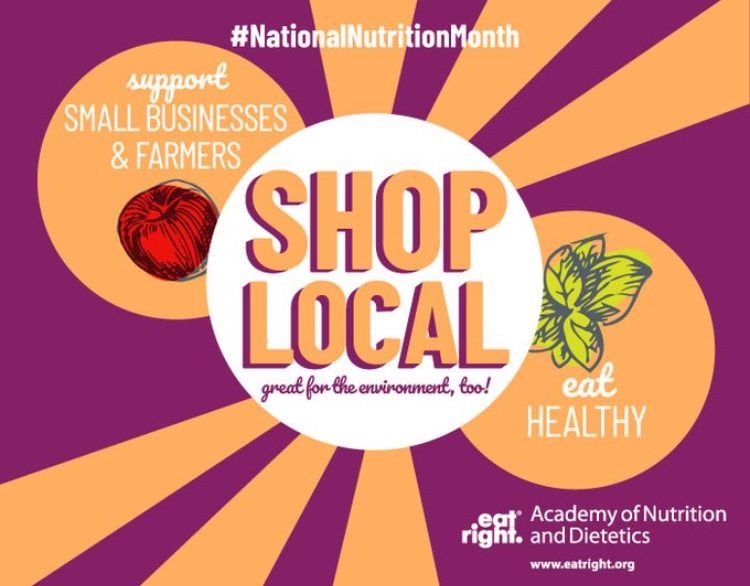
Eating and shopping locally is a huge movement. I would encourage you to go to your local farmer's market to see what's growing in your area. I've also done a few posts about what's in season year round and what's in season in autumn. 


I have a lot of clients that want a quick fix for being healthy or to be on a diet that gets them to the goal weight tomorrow. A "diet" is how you eat, your meal pattern, your food preferences. It is a lifelong thing. I'm a supporter of small, doable changes that are sustainable over a lifetime. So, here's my recipe for health


One of the most common barriers to healthy eating is cost. Many people believe that healthy eating is expensive. It doesn't have to be! Here are my 6 tips for meal planning on a budget


Healthy eating is important to prevent disease and promote health. I love starting my day off with breakfast. Breakfast provides you with fuel for the day. If you find it difficult to eat breakfast, here are a couple tips to jump start your morning and fuel your day with breakfast


Stay tuned to the blog, FacebookPinterestInstagram, and Twitter for recipes and more.


Are there any topics you want me to cover? Or, any recipes you would like to see on the blog. I'm always open to suggestions. If you have an idea, topic, or question, feel free to comment below.  


If you enjoyed this post, you may enjoy:


Monday, March 19, 2018

6 Tips to Meal Plan on a Budget

Budgets – everyone has them. Unless you’re lucky enough to have a money tree in your backyard or become rich and famous, budgeting is a reality.


Healthy eating has so many benefits. It helps children grow and develop to their full potential. It helps prevent diseases and nourishes your body.

Many of my clients state that their budget is the biggest barrier to eating healthy. I don’t think this has to be true. With a little planning, you can eat healthy and stay within your budget.

Eating healthy can be done on a budget.

Here are a few of my tips to meal plan, eat healthy, and stay on budget.

1) Make a meal plan.
- Start with a meal plan. Plan out the meals, sides, and snacks you and your family will eat for the week. Take into account any nights you may eat out.
- A meal plan helps you build a grocery list, which can help you stay on budget.

2) Make a grocery list.
- Make your grocery list at home, and stick to it at the store.
- If you’re under budget and something you regularly use is on sale, I make an exception to the grocery list “rule.”

3) Look for coupons and store discounts.
- When I meal plan, I look at my grocery store’s weekly ads and coupons on their app. If I plan meals around what’s on sale, I can easily stay on budget.


4) Eat in season.
- Produce grows at different times of the year. When produce is in season, it’s cheaper. You can find out what’s in season by checking online at More Matters or at your local farmer’s market. One of the reasons that in-season foods are cheaper is that they are grown locally and don’t have to be shipped as far. This reduces costs for the grocery store and you. 

5) Try canned or frozen produce.
- Canned or frozen fruits and vegetables can be cheaper. These foods are picked in season and preserved by canning or freezing. This is cost effective for the farmers and saves you money.
- I like to have a mix of fresh, canned, and frozen fruits and vegetables available.  I try to use my fresh produce at the beginning of the week. Then, I use the canned and frozen foods toward the end of the week.  These leads to less food waste and saves money!

6) Make things at home instead of eating out.
- The cost of a meal at a restaurant is so much higher than cooking a home. Try to cook at home more often than eating out. We try to limit eating out to 1-2 times per week. See what works for your family.
- Here’s a challenge.  Try making your favorite restaurant meal at home. Compare the prices. Also, compare the time. Does it take less time to cook the meal or drive and order the meal? I would love to hear your findings.

What are your thoughts?
Do you have any tips for healthy eating on a budget?

What's your favorite meal to make at home?

What's your favorite app for coupons or budget shopping?

For more tips and recipes for a healthy lifestyle, you can follow me on FacebookPinterestInstagram, and Twitter

If you enjoyed this post, you may enjoy:


SaveSaveSaveSave
SaveSave

Monday, October 12, 2015

RD School: What is Body Mass Index (BMI)?

RD school is a segment that I have periodically on the blog to explain things about being a RD (registered dietitian) or dietitian-related medical nutrition therapy (MNT) topics. If you are in school or have children in school, you know it's time for midterm exams. So, I thought this would be a perfect time to feature RD school. Today, we are focusing on Body Mass Index (BMI), which is a tool I use every day as a RD.

BMI, or body mass index, is the ratio of your weight to your height. Health care professionals, like dietitians, use the BMI percentiles to help classify one's BMI into categories. The categories are underweight, healthy weight, overweight, and obese. These categories provide information about health, mobility, mortality, and risk of developing chronic diseases.


BMI sometimes gets a bad wrap. However, it is a useful tool to health care professionals for the assessment of the health of their patient. The key is that it is one of many tools that can be used to assess health.

For example, most NFL (National Football League) players will have a BMI percentile that would classify them as overweight or obese. However, this BMI percentile may be skewed by the higher percent of muscle mass present in professional athletes. Dietitians may use mid-arm circumference (MAC) or body fat testing to better investigate and determine the health of a professional athlete.

BMI is still a helpful tool to assess overall health when used in conjunction with other screening tools. Some other helpful health screening tools include but are not limited to: serum lab values (blood tests including cholesterol, blood sugar, vitamin or mineral levels, etc.), muscle mass or body fat percentages, and diet history.

image via medicalnewstoday.com

You can calculate your BMI; however, know that you are not just a number. If you have questions about your health, please contact your PCP (primary care physician) and ask to speak with a dietitian. Or, you can find a dietitian near you

I hope you enjoyed this feature on RD school. I hope you learned something new or that I was able debunked any false information about BMI. Comment below if there are any health-related topics you would like featured in a segment of RD school.

For more tips and tricks for healthy eating, follow RDtipoftheday on PinterestInstagram, and Twitter.

If you enjoyed this post, you might be interested in:


Take the Healthy RD Challenge to Improve your Health One Day at a Time

Myths about Registered Dietitians


Monday, June 8, 2015

Being a College Professor: 10 Basic Principles of Nutrition


10 Basic Principles of the Science of Human Nutrition
These are the 10 basic principles of the science behind human nutrition. As a RD, this is what I work to promote. I hope to increase the public's knowledge and awareness of these basic principles along with a healthy view of nutrition, body image, and health. I couldn't have said these any better. 

"1. Food is a basic need of humans
2. Foods provide energy (calories or kcal), nutrients, and other substances needed for growth and health.
3. Health problems related to nutrition originate within cells
4. Poor nutrition can result from both inadequate and excessive levels of nutrient intake
5. Humans have adaptive mechanisms for managing fluctuations in food intake.
6. Malnutrition can result from poor diets and from disease states, genetic factors, or combinations of these causes.
7. Some groups of people are at higher risk of becoming inadequately nourished than others. Poor nutrition can influence the development of certain chronic diseases.
8. Adequacy, variety, and balance are key characteristics of a healthy diet.

9. There are no “good” or “bad” foods."

Quoted from:
Brown JE. Nutrition Through the Life Cycle. Stamford: Cengage Learning; 2014.

For more recipes, encouragement, and tips for healthy eating, follow me on PinterestInstagram, and Twitter.

Monday, April 20, 2015

#HealthyRDChallenge Roundup

How did you do with the #HealthyRD Challenge? I hope you are did well and are maybe even thinking of continuing the challenge. Simply make at least 1 healthy choice per day. 

What is the Healthy RD Challenge?
This is my challenge for each of us to take one step a day on the road to being healthier . . . the healthy road or #HealthyRD if you will. If you participate in the #HealthyRD challenge, make sure you use the hashtag #HealthyRD. Tag me on Instagram and or tweet me, @RDtipoftheday, for a chance to be featured! I am sharing the five healthy choices I'm making each day this week.  


Here's a reminder of what I did for the Healthy RD Challenge of the last 2 weeks: 


Check out the links to get ideas on living a healthier lifestyle. And for even more recipes, encouragement, and tips for healthy eating, follow me on PinterestInstagram, and Twitter .


If you enjoyed this post, you might enjoy:


Friday, April 17, 2015

Healthy RD Challenge: Day 10

How are you doing with the #HealthyRD Challenge? I hope you are doing well! 


What is the Healthy RD Challenge?
This is my challenge for each of us to take one step a day on the road to being healthier . . . the healthy road or #HealthyRD if you will. If you participate in the #HealthyRD challenge, make sure you use the hashtag #HealthyRD. Tag me on Instagram and or tweet me, @RDtipoftheday, for a chance to be featured! I am sharing the five healthy choices I'm making each day this week.  Here's a reminder of what I did for the Healthy RD Challenge last week: Day 1Day 2Day 3Day 4Day 5, Day 6, and Day 7, Day 8, and Day 9. Check out the links to get ideas on living a healthier lifestyle.


Healthy RD Challenge: Day 10
Today, I am going to try a new food and eat 5 servings of fruits and veggies today, which is my #HealthyRD Day 10 healthy choice. One healthy dietary obstacle most people face is eating enough fruits and veggies. Many people state that the taste of fruits and vegetables is the number 1 obstacle to meeting the #5aDayChallenge. So, I encourage you to try a new food. If you have tried a food before and not liked it, try the food cooked in a new way. My sister in law makes sauteed Brussels sprouts that are a Thanksgiving favorite. One of my favorite Mediterranean restaurants makes roasted cauliflower that are so delicious. If I did not try these foods, I would be missing out on some deliciously healthy foods. So, try a new food; you might just like it!


Today, I am going to meet the #5aDayChallenge. I first issued a #5aDayChallenge last summer as a way to encourage myself and others to eat 5 servings of fruits and vegetables per day. I am taking the #5aDayChallenge to become a #HealthyRD (healthier Registered Dietitian). Who's with me?

How will you choose to be healthy today?

Check with your personal RD or MD before starting a new diet or exercise program to make sure it is healthy, safe, and the right choice for you.


For more recipes, encouragement, and tips for healthy eating, follow me on PinterestInstagram, and Twitter . You can subscribe to this blog, RDtipoftheday.blogspot.com, through BlogLovin.

If you enjoyed this post, you might enjoy:


Wednesday, April 15, 2015

Healthy RD Challenge: Day 8

How are you doing with the #HealthyRD Challenge? I hope you are doing well! 


What is the Healthy RD Challenge?
This is my challenge for each of us to take one step a day on the road to being healthier . . . the healthy road or #HealthyRD if you will. If you participate in the #HealthyRD challenge, make sure you use the hashtag #HealthyRD and tag or tweet me, @RDtipoftheday, for a chance to be featured! I am sharing the five healthy choices I'm making each day this week.  Here's a reminder of what I did for the Healthy RD Challenge last week: Day 1Day 2Day 3Day 4Day 5, Day 6, and Day 7. Check out the links to get ideas on living a healthier lifestyle.


Healthy RD Challenge: Day 8
Today, I drank 8 glasses of water, which is my #HealthyRD Day 8 healthy choice. Most people can meet their water requirement with 8 cups of water per day. Each cup is 8 ounces. So, you can drink 8 cups of water per day or 64 ounces. A large percent of our bodies are water. We lose water every day, so it is important to replace that water.

Water has many functions. It helps you regulate your body temperature, cushions your joints, and is a vehicle to help you eliminate waste.


How can I drink more water?
  • Carry a bottle with water with you
    • Keep a bottle of water near you at home, work, school, or when running errands.
  • Order water at restaurants instead of a soda.
    • You will decrease your intake of sugar and calories. And, water is free at most restaurants!
  • Flavor your water.
    • If you do not prefer the taste of water, try flavoring it with fruits, vegetables, and herbs.
How will you choose to be healthy today?

Check with your personal RD or MD before starting a new diet or exercise program to make sure it is healthy, safe, and the right choice for you.


For more recipes, encouragement, and tips for healthy eating, follow me on PinterestInstagram, and Twitter . You can subscribe to this blog, RDtipoftheday.blogspot.com, through BlogLovin.

If you enjoyed this post, you might enjoy: