Tuesday, April 3, 2018

Roasted Asparagus Recipe


Happy Spring! The beginning of a new year and new seasons tend to inspire change. When the seasons change, it feels like a good time to review resolutions, set a new goal, and make healthier choices. Changes in season can inspire change in other aspects of life.

As a registered dietitian, I talk with my clients about goal setting, healthy change, and barriers to maintaining healthy changes. The main barriers to healthy eating are time, budget, lack of confidence in cooking ability, and food preferences. I work with kids, so you can read food preferences as "picky eating."


Roasting vegetables is a quick, easy way to prepare vegetables. Roasting is a cooking method that uses dry heat to cook food. It brings out a caramelized flavor through the Maillard reaction, which is a chemical reaction between amino acids and reducing sugars (reducing sugars include all monosaccharides, including sucrose, glucose, fructose, and galactose, and some disaccharides, oligosaccharides, and polysaccharides). Roasting at high temps, above 340* F, caramelizes sugar naturally found in foods. Roasting at a high temperature brings out a caramelized, nutty quality in vegetables that is super tasty. 

One of my favorite roasted vegetables is asparagus. Asparagus is in season in the US from February to June. Eating vegetables in season is a great way to save money. Produce is cheaper when it's in season.

If you or someone in your family has strong food preferences, try including them in the cooking process. This is a great beginner cook recipe or recipe to try with kids. You can break the asparagus with your hands, so you don't have to use a knife. Or, kids can help you toss vegetables with oil and seasoning. It's a great hands-on activity. 


Here's my recipe for roasted asparagus. I use the term 'recipe' loosely because this is such a quick and easy preparation. Give it a try!


Ingredients
1 bunch asparagus, rinsed and dried
1 teaspoon olive oil
1/4 teaspoon Kosher salt
1/8 teaspoon garlic powder


Tools
Half sheet pan
Spatula
Cutting board
Chef's knife

Instructions
Preheat oven to 400* F.

Rinse asparagus and pat dry. Break off the end of a few asparagus. This will give you a guide of where to cut your asparagus. Slice the bottoms of the asparagus off and discard  The top of the asparagus is tender, but the bottom of the asparagus can be tough and fibrous. 

Place asparagus on the half sheet pan. Drizzle olive oil. Sprinkle salt and garlic powder. Toss asparagus to coat.

Place in the oven for 15-20 minutes, until the vegetables are fork tender. The cooking time of asparagus varies based on the diameter of the asparagus. I've purchased asparagus that's as thick as a pencil and other asparagus is as thin as a chopstick. So, the cooking time will vary as the size of the asparagus varies.


Have you ever tried roasted vegetables? If not, I hope you try this recipe. Let me know what you think.


For more tips, encouragement, and recipes for a healthy lifestyle, you can follow me on FacebookPinterestInstagram, and Twitter. Tag me if you make any recipes!


If you liked this post, you might enjoy:


Tuesday, March 27, 2018

National Nutrition Month Roundup


We're nearing the end of March and National Nutrition Month (NNM). Here's my NNM Round-up in cased you missed anything this month.


The theme of National Nutrition Month this year was Go Further with Food.


Eating and shopping locally is a huge movement. I would encourage you to go to your local farmer's market to see what's growing in your area. I've also done a few posts about what's in season year round and what's in season in autumn. 


I have a lot of clients that want a quick fix for being healthy or to be on a diet that gets them to the goal weight tomorrow. A "diet" is how you eat, your meal pattern, your food preferences. It is a lifelong thing. I'm a supporter of small, doable changes that are sustainable over a lifetime. So, here's my recipe for health


One of the most common barriers to healthy eating is cost. Many people believe that healthy eating is expensive. It doesn't have to be! Here are my 6 tips for meal planning on a budget


Healthy eating is important to prevent disease and promote health. I love starting my day off with breakfast. Breakfast provides you with fuel for the day. If you find it difficult to eat breakfast, here are a couple tips to jump start your morning and fuel your day with breakfast


Stay tuned to the blog, FacebookPinterestInstagram, and Twitter for recipes and more.


Are there any topics you want me to cover? Or, any recipes you would like to see on the blog. I'm always open to suggestions. If you have an idea, topic, or question, feel free to comment below.  


If you enjoyed this post, you may enjoy:


Monday, March 19, 2018

6 Tips to Meal Plan on a Budget

Budgets – everyone has them. Unless you’re lucky enough to have a money tree in your backyard or become rich and famous, budgeting is a reality.


Healthy eating has so many benefits. It helps children grow and develop to their full potential. It helps prevent diseases and nourishes your body.

Many of my clients state that their budget is the biggest barrier to eating healthy. I don’t think this has to be true. With a little planning, you can eat healthy and stay within your budget.

Eating healthy can be done on a budget.

Here are a few of my tips to meal plan, eat healthy, and stay on budget.

1) Make a meal plan.
- Start with a meal plan. Plan out the meals, sides, and snacks you and your family will eat for the week. Take into account any nights you may eat out.
- A meal plan helps you build a grocery list, which can help you stay on budget.

2) Make a grocery list.
- Make your grocery list at home, and stick to it at the store.
- If you’re under budget and something you regularly use is on sale, I make an exception to the grocery list “rule.”

3) Look for coupons and store discounts.
- When I meal plan, I look at my grocery store’s weekly ads and coupons on their app. If I plan meals around what’s on sale, I can easily stay on budget.


4) Eat in season.
- Produce grows at different times of the year. When produce is in season, it’s cheaper. You can find out what’s in season by checking online at More Matters or at your local farmer’s market. One of the reasons that in-season foods are cheaper is that they are grown locally and don’t have to be shipped as far. This reduces costs for the grocery store and you. 

5) Try canned or frozen produce.
- Canned or frozen fruits and vegetables can be cheaper. These foods are picked in season and preserved by canning or freezing. This is cost effective for the farmers and saves you money.
- I like to have a mix of fresh, canned, and frozen fruits and vegetables available.  I try to use my fresh produce at the beginning of the week. Then, I use the canned and frozen foods toward the end of the week.  These leads to less food waste and saves money!

6) Make things at home instead of eating out.
- The cost of a meal at a restaurant is so much higher than cooking a home. Try to cook at home more often than eating out. We try to limit eating out to 1-2 times per week. See what works for your family.
- Here’s a challenge.  Try making your favorite restaurant meal at home. Compare the prices. Also, compare the time. Does it take less time to cook the meal or drive and order the meal? I would love to hear your findings.

What are your thoughts?
Do you have any tips for healthy eating on a budget?

What's your favorite meal to make at home?

What's your favorite app for coupons or budget shopping?

For more tips and recipes for a healthy lifestyle, you can follow me on FacebookPinterestInstagram, and Twitter

If you enjoyed this post, you may enjoy:


SaveSaveSaveSave
SaveSave

Monday, March 12, 2018

Recipe for Health

What’s the recipe for being healthy?

I would say it’s fueling your body with healthy foods + mental health + emotional health + adequate rest + activity. Today, we are focusing on one piece of the health recipe, physical activity. Activity is any form of movement that you enjoy.


I feel like the term "exercise" gets a bad rap. For most of my clients, exercise is kind of a dirty word. It tends to be associated with a “should do” or “have to” mentality. What I mean by that is, most people say a “should exercise” or I “have to” exercise.

Physical activity or movement is something that is important to your health. We know physical activity increases in strength, cardiovascular endurance, flexibility, and so much more.


How do you change a “should” into a “want to”?

I think we can enjoy exercise. Find something you love to do that gets you moving. I love dancing, so I tried several types of dance and barre classes. I also LOVE the water, so water sports are one of my favorite ways to be physically active, when the weather is cooperative. 


What are examples of physical activity?

Physical activity can be done anywhere – inside your home, at a park, at the gym. It doesn’t have to be expensive. You don’t have to join a gym. You can walk around your neighborhood or dance to music in the comfort and privacy of your own home. You can join a recreational sports league. There are so many different types of physical activity: sports, walking, swimming, exercise classes, strength-training, cycling, dance, yoga, Pilates, rock climbing, step class, kayaking, etc. I challenge you to try something new.

My challenge to you is to try something new.


What are your thoughts?

What type of physical activity do you enjoy?

What keeps you motivated to be physically active?

Have you tried any new types of physical activity?

I would love to hear your thoughts. Comment below or on Instagram, and Twitter.

If you enjoyed this post, you may enjoy:


5 Tips to Eat More Fruits & Vegetables 

For more tips, encouragement, and recipes for a healthy lifestyle, you can follow me on FacebookPinterestInstagram, and Twitter

Monday, March 5, 2018

Fuel Your Day with Breakfast

What’s the most important meal of the day? Did you say breakfast?


I would content that all meals are important. Much research has been conducted around breakfast. We know breakfast is an important meal.
  • Breakfast helps jumpstart our metabolism after fasting all night.
  • Kids that eat breakfast do better in school (1).
  • Eating meals and snacks throughout the day helps reduce hanger (you know – hunger-induced anger). This is both funny and true. Low-blood sugar, which can result from skipping meals, increases irritability. So friends, hanger is real.
I’ve been a registered dietitian (RD) for almost 10 years.  Many of my clients have several common barriers to eating breakfast. The most common barriers are time and lack of appetite. 


If you are rushed in the morning, consider these time savers:

1) Make breakfast the night before.
- You can have breakfast for dinner and reheat leftovers in the morning.  Try my frittata recipe. It’s great for breakfast, brunch, or breakfast for dinner.


2) Prep for a quick breakfast.
- Make a smoothie pack in the freezer. In the morning, you can blend the smoothie
- Try overnight oats or museli. These breakfast cereals can be mixed with milk, yogurt, or a dairy alternative and can sit in the fridge overnight.  Try adding fruits or nuts to have a balanced breakfast with a variety of foods.

3) Build a balanced meal.
To build a healthy meal, incorporate at least 3 different food groups. Try to include 1 or 2 servings of fruits or vegetables at every meal.


4) Try drinking your breakfast.
If you don’t have a big appetite in the morning and you're pushed for time, try having a small breakfast or drinking your breakfast. Try a smoothie or fruit and yogurt. These are small, quick and easy breakfasts.


What are your thoughts?
What is your favorite thing to eat for breakfast?
Do you find it easy or difficult to eat breakfast?
I would love to hear your thoughts. Feel free to comment below or comment on Instagram or Twitter.

If you enjoyed this post, you may enjoy:


References:

1) Faught et Al. Healthy lifestyle behaviors are positively and independently associated with acadmic achievement: An analysis of self-reported data from a nationally representative sample of Canadian early adolescents. PLoS One: 2017; 12 (7). Available at: https://www.ncbi.nlm.nih.gov/pmc/articles/PMC5533436/.
SaveSaveSaveSaveSaveSave

Thursday, March 1, 2018

National Nutrition Month 2018

National Nutrition Month is a celebration held every March since 1980. It was created by the Academy of Nutrition and Dietetics (AND). Every year there is a different theme to promote nutrition education. The theme for 2018 is Go Further with Food. This year’s theme emphasizes the importance of fueling your body with healthy foods and physical activity. This month we will cover the following topics: breakfast, nutrition and physical activity, and healthy eating on a budget.

National Nutrition Month 2018

As a registered dietitian (RD), my goal is to provide helpful nutrition information that is supported by science. I want you to be an informed consumer. To be an informed consumer, look at the author’s credentials to determine their depth of knowledge and qualifications to cover a subject. If you want to know more about my qualifications or how to become a RD, check out the following posts.


I hope you have a fantastic March. Let me know if you have any nutrition-related questions in the comments.

If you enjoyed this post, you may enjoy:


Monday, February 5, 2018

King Cake Recipe


It's Epiphany season, the time between Christmas and Easter. If you grew up in Louisiana, you also know this means King Cake season!


There's a ton of history behind king cake. It is available after Epiphany or King's Day, which is a Christian holiday held 12 nights after Christmas. Epiphany celebrates the three wise men or "kings" finding baby Jesus the savior of the world.

The colors of the sprinkles that top the King Cake are significant. Some say they represent the wise men that visited baby Jesus. Others say that the colors represent the three gifts brought, frankincense, gold, and myrrh. Others say that purple represents God's justice, green represents faith in Christ, and gold represents God's power.

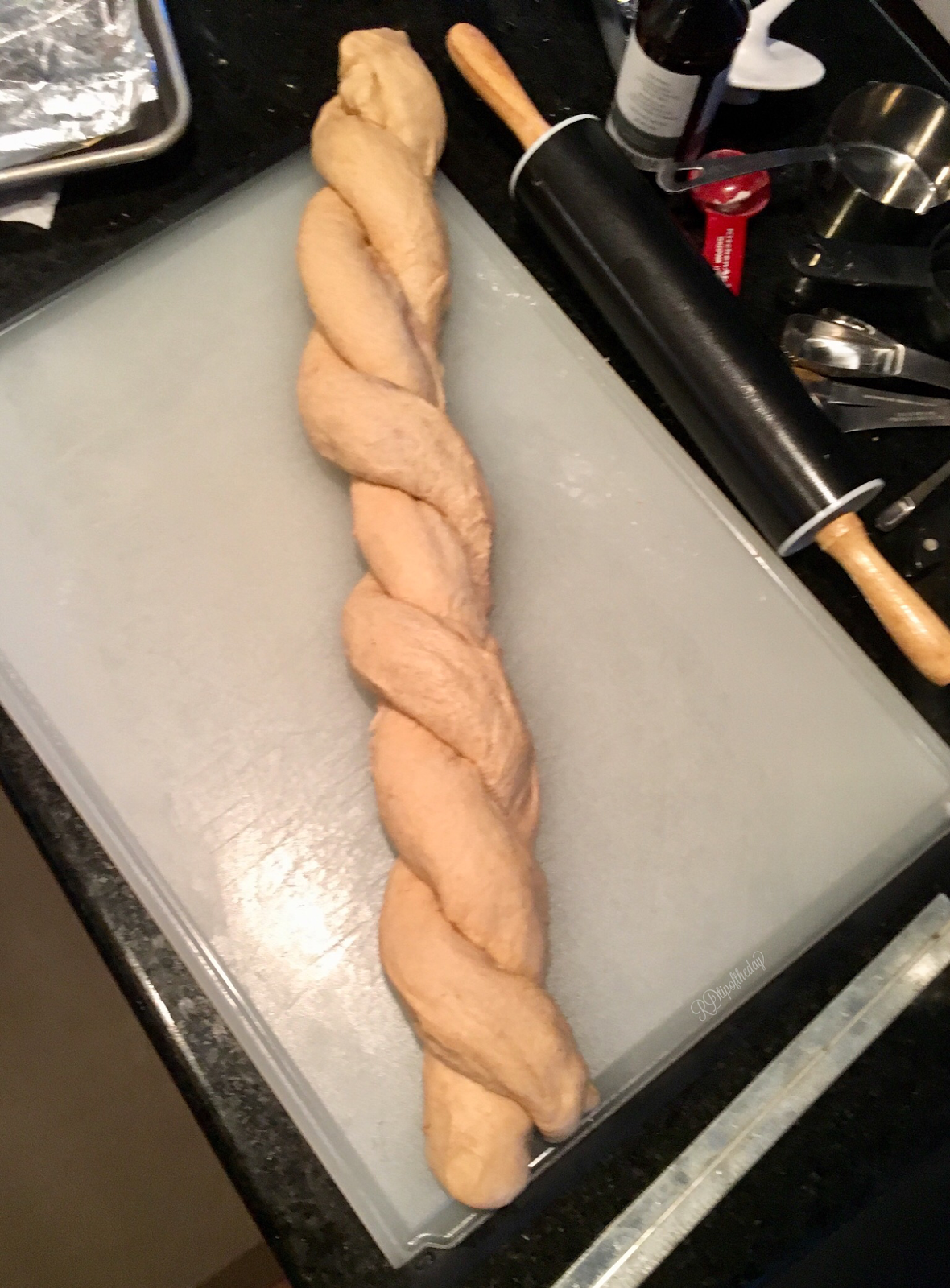
The shape of the King Cake is braided or twisted dough shaped into an oval. This shape represents a crown. The braids or twists represent unity of faith. 


There is usually a small, plastic baby in the King Cake. The baby represents baby Jesus. And, finding the baby echoes the wise men finding baby Jesus. Whoever gets the slice of King Cake with the baby is responsible for bringing the next King Cake.

Don't you love when food tells a story?


If you've never had king cake, it's similar to a yeast-based, brioche-style cinnamon roll. All those things translate to delicious! It's topped with a yummy icing and purple, green, and gold sprinkles. So good!

There are a few steps to making a king cake. But, they're all easy steps. This recipe makes a huge king cake that is great for sharing. Throw a party! And, introduce all your friends to king cake.


Ingredients
Dough
1 cup whole milk, warmed to 120-130*F (or per yeast package instructions)
½ cup granulated sugar
3 packets active dry yeast
4 ½ cups all-purpose flour (plus more if dough is overly sticky)
¾ teaspoon salt
1 cup (2 sticks) unsalted butter, melted
2 eggs
2 ½ teaspoons ground cinnamon
½ teaspoon ground nutmeg

Filling
½ cup (1 stick butter), softened to room temperature
2 teaspoons ground cinnamon
1 cup granulated sugar
¼ teaspoon salt

Glaze
2 cups powdered sugar
2 Tablespoons milk
1 teaspoon vanilla extract
½ teaspoon fresh lemon juice
Purple, green, and gold sprinkles

Equipment
Liquid measuring cup
Measuring cups
Measuring spoons
Wisk
Large mixing bowl or stand mixer with dough attachment
Spatula
Large oven-safe bowl
Large cutting board
Kitchen knife
Ruler
Cling film
9x13 sheet tray
Cooking spray
Aluminum foil

Instructions
Microwave milk in a microwave safe container for 30-45 seconds until milk reaches 120-130*F. Add sugar. Whisk until dissolved. Add yeast. Whisk and let sit 5-10 minutes until foamy.

In a stand mixer, add melted butter and eggs. Mix to combine.

Add yeast mixture. Mix until combined.

In a large mixing bowl, combine flour, salt, cinnamon, and nutmeg. Add dry ingredients to wet ingredients in stand mixer. Mix until combined.

Change mixer to a dough hook. Mix for 5 minutes. My dough was overly sticky, so I added 3 Tablespoons of flour, one at a time.

Oil a large mixing bowl. Place dough in bowl, and cover with cling film. Let rise in a warm place for 2 hours.

Make the filling. Mix butter, sugar, cinnamon, and salt until well combined. Set aside.

Make the glaze. Mix powdered sugar, milk, and vanilla.

Preheat oven to 375*F.

When dough has doubled in size, divide in two. Place ½ of dough onto a large cutting board. Roll out dough to 20 inches long by 4-6 inches high. Spread half off the filling on the dough with an offset spatula. Roll the shorter side of the dough onto itself like you’re making cinnamon rolls.

Repeat the process with the second half of dough.

Place both pieces of dough on a 9 x 13 inch baking sheet side by side. Stretch both rolls to 20-24 inches. 


Twist dough together. Start at the center. 


Shape dough into a circle by bringing the two ends to meet. Pinch ends together to form a complete circle.


Let the dough proof for 45-60 minutes.


Bake for 30 minutes until golden brown and delicious.


Let cake cool. Drizzle glaze on cake and sprinkle sections with sugar. Alternate sprinkling sections with purple, green and gold sprinkles. Cut a wedge and enjoy!

If you enjoyed this post, you might enjoy: